---
comments: true
description: Explore the Carparts Segmentation Dataset for automotive AI applications. Enhance your segmentation models with rich, annotated data using Ultralytics YOLO.
keywords: Carparts Segmentation Dataset, computer vision, automotive AI, vehicle maintenance, Ultralytics, YOLO, segmentation models, deep learning, object segmentation
---
# Carparts Segmentation Dataset
The Carparts Segmentation Dataset is a curated collection of images and videos designed for [computer vision](https://www.ultralytics.com/glossary/computer-vision-cv) applications, specifically focusing on [segmentation tasks](https://docs.ultralytics.com/tasks/segment/). This dataset provides a diverse set of visuals captured from multiple perspectives, offering valuable [annotated](https://www.ultralytics.com/glossary/data-labeling) examples for training and testing segmentation models.
Whether you're working on [automotive research](https://www.ultralytics.com/solutions/ai-in-automotive), developing AI solutions for vehicle maintenance, or exploring computer vision applications, the Carparts Segmentation Dataset serves as a valuable resource for enhancing the [accuracy](https://www.ultralytics.com/glossary/accuracy) and efficiency of your projects using models like [Ultralytics YOLO](../../models/yolo26.md).
## Dataset Structure
The data distribution within the Carparts Segmentation Dataset is organized as follows:
- **Training set**: Includes 3156 images, each accompanied by its corresponding annotations. This set is used for [training](https://www.ultralytics.com/glossary/training-data) the [deep learning](https://www.ultralytics.com/glossary/deep-learning-dl) [model](https://www.ultralytics.com/glossary/foundation-model).
- **Testing set**: Comprises 276 images, with each one paired with its respective annotations. This set is used to evaluate the model's performance after training using [test data](https://www.ultralytics.com/glossary/test-data).
- **Validation set**: Consists of 401 images, each having corresponding annotations. This set is used during training to tune [hyperparameters](https://docs.ultralytics.com/guides/hyperparameter-tuning/) and prevent [overfitting](https://www.ultralytics.com/glossary/overfitting) using [validation data](https://www.ultralytics.com/glossary/validation-data).
## Applications
Carparts Segmentation finds applications in various domains including:
- **Automotive Quality Control**: Identifying defects or inconsistencies in car parts during manufacturing ([AI in Manufacturing](https://www.ultralytics.com/solutions/ai-in-manufacturing)).
- **Auto Repair**: Assisting mechanics in identifying parts for repair or replacement.
- **E-commerce Cataloging**: Automatically tagging and categorizing car parts in online stores for [e-commerce](https://en.wikipedia.org/wiki/E-commerce) platforms.
- **Traffic Monitoring**: Analyzing vehicle components in traffic surveillance footage.
- **Autonomous Vehicles**: Enhancing the perception systems of [self-driving cars](https://www.ultralytics.com/blog/ai-in-self-driving-cars) to better understand surrounding vehicles.
- **Insurance Processing**: Automating damage assessment by identifying affected car parts during insurance claims.
- **Recycling**: Sorting vehicle components for efficient recycling processes.
- **Smart City Initiatives**: Contributing data for urban planning and traffic management systems within [Smart Cities](https://en.wikipedia.org/wiki/Smart_city).
By accurately identifying and categorizing different vehicle components, carparts segmentation streamlines processes and contributes to increased efficiency and automation across these industries.
## Dataset YAML
A [YAML](https://www.ultralytics.com/glossary/yaml) (Yet Another Markup Language) file defines the dataset configuration, including paths, class names, and other essential details. For the Carparts Segmentation dataset, the `carparts-seg.yaml` file is available at [https://github.com/ultralytics/ultralytics/blob/main/ultralytics/cfg/datasets/carparts-seg.yaml](https://github.com/ultralytics/ultralytics/blob/main/ultralytics/cfg/datasets/carparts-seg.yaml). You can learn more about the YAML format at [yaml.org](https://yaml.org/).
!!! example "ultralytics/cfg/datasets/carparts-seg.yaml"
```yaml
--8<-- "ultralytics/cfg/datasets/carparts-seg.yaml"
```
## Usage
To train an [Ultralytics YOLO26](../../models/yolo26.md) model on the Carparts Segmentation dataset for 100 [epochs](https://www.ultralytics.com/glossary/epoch) with an image size of 640, use the following code snippets. Refer to the model [Training guide](../../modes/train.md) for a comprehensive list of available arguments and explore [model training tips](https://docs.ultralytics.com/guides/model-training-tips/) for best practices.
!!! example "Train Example"
=== "Python"
```python
from ultralytics import YOLO
# Load a pretrained segmentation model like YOLO26n-seg
model = YOLO("yolo26n-seg.pt") # load a pretrained model (recommended for training)
# Train the model on the Carparts Segmentation dataset
results = model.train(data="carparts-seg.yaml", epochs=100, imgsz=640)
# After training, you can validate the model's performance on the validation set
results = model.val()
# Or perform prediction on new images or videos
results = model.predict("path/to/your/image.jpg")
```
=== "CLI"
```bash
# Start training from a pretrained *.pt model using the Command Line Interface
# Specify the dataset config file, model, number of epochs, and image size
yolo segment train data=carparts-seg.yaml model=yolo26n-seg.pt epochs=100 imgsz=640
# Validate the trained model using the validation set
yolo segment val data=carparts-seg.yaml model=path/to/best.pt
# Predict using the trained model on a specific image source
yolo segment predict model=path/to/best.pt source=path/to/your/image.jpg
```
## Sample Data and Annotations
The Carparts Segmentation dataset includes a diverse array of images and videos captured from various perspectives. Below are examples showcasing the data and its corresponding annotations:
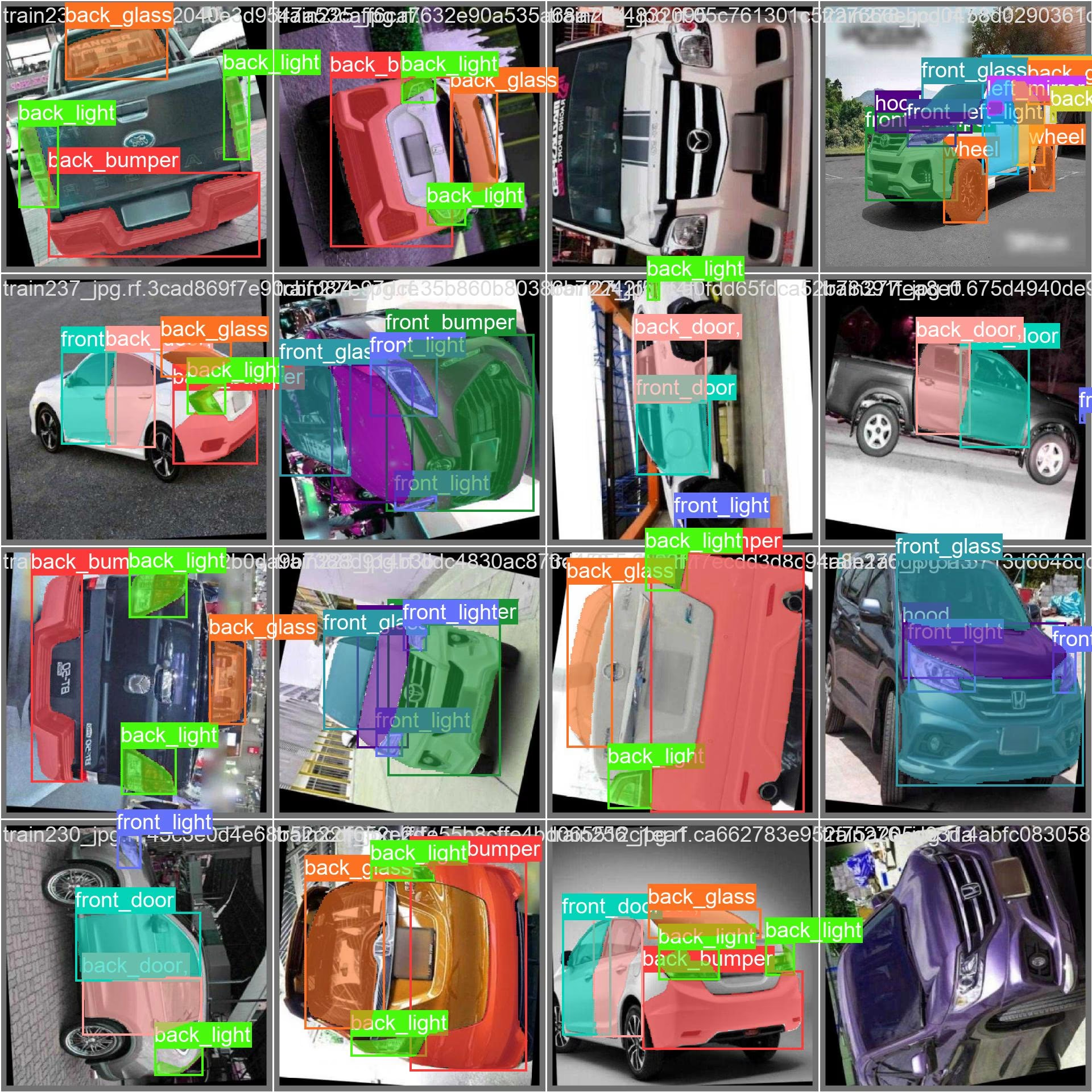
- The image demonstrates [object segmentation](https://docs.ultralytics.com/tasks/segment/) within a car image sample. Annotated [bounding boxes](https://www.ultralytics.com/glossary/bounding-box) with masks highlight the identified car parts (e.g., headlights, grille).
- The dataset features a variety of images captured under different conditions (locations, lighting, object densities), providing a comprehensive resource for training robust car part segmentation models.
- This example underscores the dataset's complexity and the importance of [high-quality data](https://www.ultralytics.com/blog/the-importance-of-high-quality-computer-vision-datasets) for computer vision tasks, especially in specialized domains like automotive component analysis. Techniques like [data augmentation](https://www.ultralytics.com/glossary/data-augmentation) can further enhance model generalization.
## Citations and Acknowledgments
If you utilize the Carparts Segmentation dataset in your research or development efforts, please cite the original source:
!!! quote ""
=== "BibTeX"
```bibtex
@misc{ car-seg-un1pm_dataset,
title = { car-seg Dataset },
type = { Open Source Dataset },
author = { Gianmarco Russo },
url = { https://universe.roboflow.com/gianmarco-russo-vt9xr/car-seg-un1pm },
year = { 2023 },
month = { nov },
note = { visited on 2024-01-24 },
}
```
We acknowledge the contribution of Gianmarco Russo and the Roboflow team in creating and maintaining this valuable dataset for the computer vision community. For more datasets, visit the [Ultralytics Datasets collection](https://docs.ultralytics.com/datasets/).
## FAQ
### What is the Carparts Segmentation Dataset?
The Carparts Segmentation Dataset is a specialized collection of images and videos for training computer vision models to perform [segmentation](https://docs.ultralytics.com/tasks/segment/) on car parts. It includes diverse visuals with detailed annotations, suitable for automotive AI applications.
### How can I use the Carparts Segmentation Dataset with Ultralytics YOLO26?
You can train an [Ultralytics YOLO26](../../models/yolo26.md) segmentation model using this dataset. Load a pretrained model (e.g., `yolo26n-seg.pt`) and initiate training using the provided Python or CLI examples, referencing the `carparts-seg.yaml` configuration file. Check the [Training Guide](../../modes/train.md) for detailed instructions.
!!! example "Train Example Snippet"
=== "Python"
```python
from ultralytics import YOLO
# Load a model
model = YOLO("yolo26n-seg.pt") # load a pretrained model (recommended for training)
# Train the model
results = model.train(data="carparts-seg.yaml", epochs=100, imgsz=640)
```
=== "CLI"
```bash
yolo segment train data=carparts-seg.yaml model=yolo26n-seg.pt epochs=100 imgsz=640
```
### What are some applications of Carparts Segmentation?
Carparts Segmentation is useful in:
- **Automotive Quality Control**: Ensuring parts meet standards ([AI in Manufacturing](https://www.ultralytics.com/solutions/ai-in-manufacturing)).
- **Auto Repair**: Identifying parts needing service.
- **E-commerce**: Cataloging parts online.
- **Autonomous Vehicles**: Improving vehicle perception ([AI in Automotive](https://www.ultralytics.com/solutions/ai-in-automotive)).
- **Insurance**: Assessing vehicle damage automatically.
- **Recycling**: Sorting parts efficiently.
### Where can I find the dataset configuration file for Carparts Segmentation?
The dataset configuration file, `carparts-seg.yaml`, which contains details about the dataset paths and classes, is located in the Ultralytics GitHub repository: [carparts-seg.yaml](https://github.com/ultralytics/ultralytics/blob/main/ultralytics/cfg/datasets/carparts-seg.yaml).
### Why should I use the Carparts Segmentation Dataset?
This dataset offers rich, annotated data crucial for developing accurate [segmentation models](https://docs.ultralytics.com/tasks/segment/) for automotive applications. Its diversity helps improve model robustness and performance in real-world scenarios like automated vehicle inspection, enhancing safety systems, and supporting autonomous driving technology. Using high-quality, domain-specific datasets like this accelerates AI development.
