---
comments: true
description: YOLO26 from Ultralytics delivers faster, simpler, end-to-end NMS-free object detection optimized for edge and low-power devices.
keywords: YOLO26, Ultralytics YOLO, object detection, end-to-end NMS-free, simplified architecture, computer vision, AI, machine learning, edge AI, low power devices, quantization, real-time inference
---
# Ultralytics YOLO26
## Overview
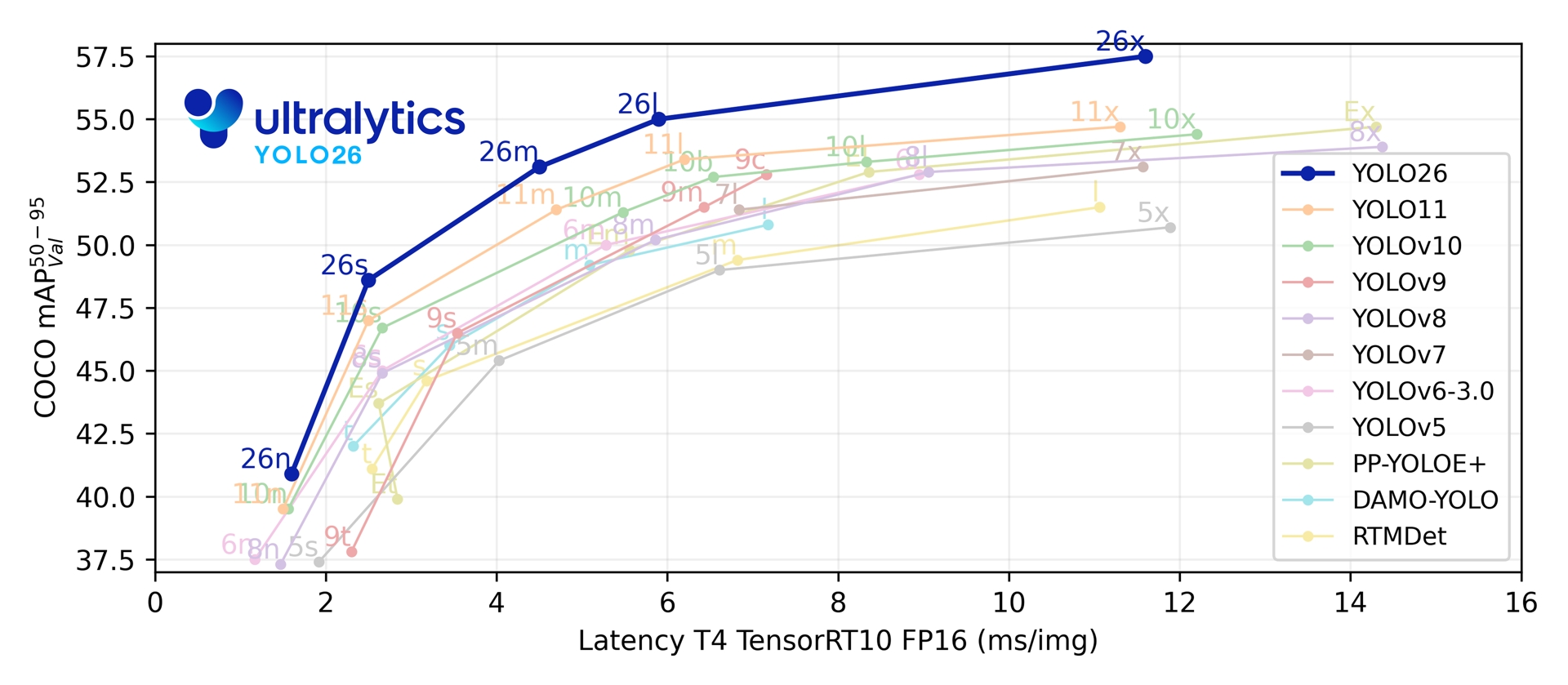
[Ultralytics](https://www.ultralytics.com/) YOLO26 is the latest evolution in the YOLO series of real-time object detectors, engineered from the ground up for **edge and low-power devices**. It introduces a streamlined design that removes unnecessary complexity while integrating targeted innovations to deliver faster, lighter, and more accessible deployment.
!!! tip "Try on Ultralytics Platform"
Explore and run YOLO26 models directly on [Ultralytics Platform](https://platform.ultralytics.com/ultralytics/yolo26).
The architecture of YOLO26 is guided by three core principles:
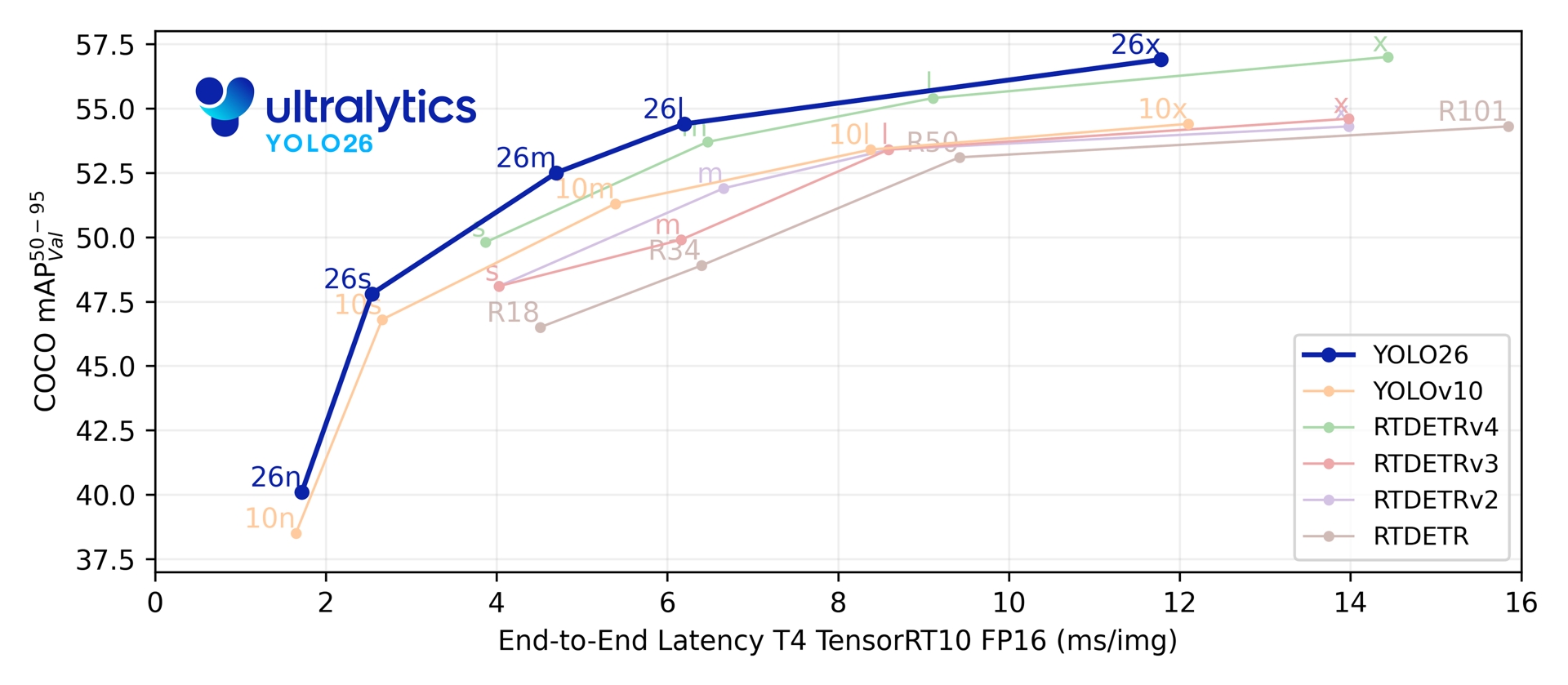
- **Simplicity:** YOLO26 is a **native end-to-end model**, producing predictions directly without the need for non-maximum suppression (NMS). By eliminating this post-processing step, inference becomes faster, lighter, and easier to deploy in real-world systems. This breakthrough approach was first pioneered in [YOLOv10](../models/yolov10.md) by Ao Wang at Tsinghua University and has been further advanced in YOLO26.
- **Deployment Efficiency:** The end-to-end design cuts out an entire stage of the pipeline, dramatically simplifying integration, reducing latency, and making deployment more robust across diverse environments.
- **Training Innovation:** YOLO26 introduces the **MuSGD optimizer**, a hybrid of [SGD](https://docs.pytorch.org/docs/stable/generated/torch.optim.SGD.html) and [Muon](https://arxiv.org/abs/2502.16982) — inspired by Moonshot AI's [Kimi K2](https://www.kimi.com/) breakthroughs in LLM training. This optimizer brings enhanced stability and faster convergence, transferring optimization advances from language models into computer vision.
- **Task-Specific Optimizations:** YOLO26 introduces targeted improvements for specialized tasks, including semantic segmentation loss and multi-scale proto modules for **Segmentation**, Residual Log-Likelihood Estimation (RLE) for high-precision **Pose** estimation, and optimized decoding with angle loss to resolve boundary issues in **OBB**.
Together, these innovations deliver a model family that achieves higher accuracy on small objects, provides seamless deployment, and runs **up to 43% faster on CPUs** — making YOLO26 one of the most practical and deployable YOLO models to date for resource-constrained environments.
## Key Features
- **DFL Removal**
The Distribution Focal Loss (DFL) module, while effective, often complicated export and limited hardware compatibility. YOLO26 removes DFL entirely, simplifying inference and broadening support for **edge and low-power devices**.
- **End-to-End NMS-Free Inference**
Unlike traditional detectors that rely on NMS as a separate post-processing step, YOLO26 is **natively end-to-end**. Predictions are generated directly, reducing latency and making integration into production systems faster, lighter, and more reliable.
- **ProgLoss + STAL**
Improved loss functions increase detection accuracy, with notable improvements in **small-object recognition**, a critical requirement for IoT, robotics, aerial imagery, and other edge applications.
- **MuSGD Optimizer**
A new hybrid optimizer that combines [SGD](https://docs.pytorch.org/docs/stable/generated/torch.optim.SGD.html) with [Muon](https://arxiv.org/abs/2502.16982). Inspired by Moonshot AI's [Kimi K2](https://www.kimi.com/), MuSGD introduces advanced optimization methods from LLM training into computer vision, enabling more stable training and faster convergence.
- **Up to 43% Faster CPU Inference**
Specifically optimized for edge computing, YOLO26 delivers significantly faster CPU inference, ensuring real-time performance on devices without GPUs.
- **Instance Segmentation Enhancements**
Introduces semantic segmentation loss to improve model convergence and an upgraded proto module that leverages multi-scale information for superior mask quality.
- **Precision Pose Estimation**
Integrates [Residual Log-Likelihood Estimation](https://arxiv.org/abs/2107.11291) (RLE) for more accurate keypoint localization and optimizes the decoding process for increased inference speed.
- **Refined OBB Decoding**
Introduces a specialized angle loss to improve detection accuracy for square-shaped objects and optimizes OBB decoding to resolve boundary discontinuity issues.
---
## Supported Tasks and Modes
YOLO26 builds upon the versatile model range established by earlier Ultralytics YOLO releases, offering enhanced support across various computer vision tasks:
| Model | Filenames | Task | Inference | Validation | Training | Export |
| ----------- | ----------------------------------------------------------------------------------------- | -------------------------------------------- | --------- | ---------- | -------- | ------ |
| YOLO26 | `yolo26n.pt` `yolo26s.pt` `yolo26m.pt` `yolo26l.pt` `yolo26x.pt` | [Detection](../tasks/detect.md) | ✅ | ✅ | ✅ | ✅ |
| YOLO26-seg | `yolo26n-seg.pt` `yolo26s-seg.pt` `yolo26m-seg.pt` `yolo26l-seg.pt` `yolo26x-seg.pt` | [Instance Segmentation](../tasks/segment.md) | ✅ | ✅ | ✅ | ✅ |
| YOLO26-pose | `yolo26n-pose.pt` `yolo26s-pose.pt` `yolo26m-pose.pt` `yolo26l-pose.pt` `yolo26x-pose.pt` | [Pose/Keypoints](../tasks/pose.md) | ✅ | ✅ | ✅ | ✅ |
| YOLO26-obb | `yolo26n-obb.pt` `yolo26s-obb.pt` `yolo26m-obb.pt` `yolo26l-obb.pt` `yolo26x-obb.pt` | [Oriented Detection](../tasks/obb.md) | ✅ | ✅ | ✅ | ✅ |
| YOLO26-cls | `yolo26n-cls.pt` `yolo26s-cls.pt` `yolo26m-cls.pt` `yolo26l-cls.pt` `yolo26x-cls.pt` | [Classification](../tasks/classify.md) | ✅ | ✅ | ✅ | ✅ |
This unified framework ensures YOLO26 is applicable across real-time detection, segmentation, classification, pose estimation, and oriented object detection — all with training, validation, inference, and export support.
---
## Performance Metrics
!!! tip "Performance"
=== "Detection (COCO)"
See [Detection Docs](../tasks/detect.md) for usage examples with these models trained on [COCO](../datasets/detect/coco.md), which include 80 pretrained classes.
--8<-- "docs/macros/yolo-det-perf.md"
=== "Segmentation (COCO)"
See [Segmentation Docs](../tasks/segment.md) for usage examples with these models trained on [COCO](../datasets/segment/coco.md), which include 80 pretrained classes.
--8<-- "docs/macros/yolo-seg-perf.md"
=== "Classification (ImageNet)"
See [Classification Docs](../tasks/classify.md) for usage examples with these models trained on [ImageNet](../datasets/classify/imagenet.md), which include 1000 pretrained classes.
--8<-- "docs/macros/yolo-cls-perf.md"
=== "Pose (COCO)"
See [Pose Estimation Docs](../tasks/pose.md) for usage examples with these models trained on [COCO](../datasets/pose/coco.md), which include 1 pretrained class, 'person'.
--8<-- "docs/macros/yolo-pose-perf.md"
=== "OBB (DOTAv1)"
See [Oriented Detection Docs](../tasks/obb.md) for usage examples with these models trained on [DOTAv1](../datasets/obb/dota-v2.md#dota-v10), which include 15 pretrained classes.
--8<-- "docs/macros/yolo-obb-perf.md"
---
## Usage Examples
This section provides simple YOLO26 training and inference examples. For full documentation on these and other [modes](../modes/index.md), see the [Predict](../modes/predict.md), [Train](../modes/train.md), [Val](../modes/val.md), and [Export](../modes/export.md) docs pages.
Note that the example below is for YOLO26 [Detect](../tasks/detect.md) models for [object detection](https://www.ultralytics.com/glossary/object-detection). For additional supported tasks, see the [Segment](../tasks/segment.md), [Classify](../tasks/classify.md), [OBB](../tasks/obb.md), and [Pose](../tasks/pose.md) docs.
!!! example
=== "Python"
[PyTorch](https://www.ultralytics.com/glossary/pytorch) pretrained `*.pt` models as well as configuration `*.yaml` files can be passed to the `YOLO()` class to create a model instance in Python:
```python
from ultralytics import YOLO
# Load a COCO-pretrained YOLO26n model
model = YOLO("yolo26n.pt")
# Train the model on the COCO8 example dataset for 100 epochs
results = model.train(data="coco8.yaml", epochs=100, imgsz=640)
# Run inference with the YOLO26n model on the 'bus.jpg' image
results = model("path/to/bus.jpg")
```
=== "CLI"
CLI commands are available to directly run the models:
```bash
# Load a COCO-pretrained YOLO26n model and train it on the COCO8 example dataset for 100 epochs
yolo train model=yolo26n.pt data=coco8.yaml epochs=100 imgsz=640
# Load a COCO-pretrained YOLO26n model and run inference on the 'bus.jpg' image
yolo predict model=yolo26n.pt source=path/to/bus.jpg
```
!!! note "Dual-Head Architecture"
YOLO26 features a **dual-head architecture** that provides flexibility for different deployment scenarios:
- **One-to-One Head (Default)**: Produces end-to-end predictions without NMS, outputting `(N, 300, 6)` with a maximum of 300 detections per image. This head is optimized for fast inference and simplified deployment.
- **One-to-Many Head**: Generates traditional YOLO outputs requiring NMS post-processing, outputting `(N, nc + 4, 8400)` where `nc` is the number of classes. This head typically achieves slightly higher accuracy at the cost of additional processing.
You can switch between heads during export, prediction, or validation:
=== "Python"
```python
from ultralytics import YOLO
model = YOLO("yolo26n.pt")
# Use one-to-one head (default, no NMS required)
results = model.predict("image.jpg") # inference
metrics = model.val(data="coco.yaml") # validation
model.export(format="onnx") # export
# Use one-to-many head (requires NMS)
results = model.predict("image.jpg", end2end=False) # inference
metrics = model.val(data="coco.yaml", end2end=False) # validation
model.export(format="onnx", end2end=False) # export
```
=== "CLI"
```bash
# Use one-to-one head (default, no NMS required)
yolo predict model=yolo26n.pt source=image.jpg
yolo val model=yolo26n.pt data=coco.yaml
yolo export model=yolo26n.pt format=onnx
# Use one-to-many head (requires NMS)
yolo predict model=yolo26n.pt source=image.jpg end2end=False
yolo val model=yolo26n.pt data=coco.yaml end2end=False
yolo export model=yolo26n.pt format=onnx end2end=False
```
The choice depends on your deployment requirements: use the one-to-one head for maximum speed and simplicity, or the one-to-many head when accuracy is the top priority.
## YOLOE-26: Open-Vocabulary Instance Segmentation
YOLOE-26 integrates the high-performance YOLO26 architecture with the open-vocabulary capabilities of the [YOLOE](yoloe.md) series. It enables real-time detection and segmentation of any object class using **text prompts**, **visual prompts**, or a **prompt-free mode** for zero-shot inference, effectively removing the constraints of fixed-category training.
By leveraging YOLO26's **NMS-free, end-to-end design**, YOLOE-26 delivers fast open-world inference. This makes it a powerful solution for edge applications in dynamic environments where the objects of interest represent a broad and evolving vocabulary.
!!! tip "Performance"
=== "Text/Visual Prompts"
See [YOLOE Docs](./yoloe.md) for usage examples with these models trained on [Objects365v1](https://opendatalab.com/OpenDataLab/Objects365_v1), [GQA](https://cs.stanford.edu/people/dorarad/gqa/about.html) and [Flickr30k](https://shannon.cs.illinois.edu/DenotationGraph/) datasets.
| Model | size
(pixels) | Prompt Type | mAPminival
50-95(e2e) | mAPminival
50-95 | mAPr | mAPc | mAPf | params
(M) | FLOPs
(B) |
|---------------|-----------------------------|-------------|-------------------------------------|----------------------------|-----------------|-----------------|-----------------|--------------------------|-------------------------|
| [YOLOE-26n-seg](https://github.com/ultralytics/assets/releases/download/v8.4.0/yoloe-26n-seg.pt) | 640 | Text/Visual | 23.7 / 20.9 | 24.7 / 21.9 | 20.5 / 17.6 | 24.1 / 22.3 | 26.1 / 22.4 | 4.8 | 6.0 |
| [YOLOE-26s-seg](https://github.com/ultralytics/assets/releases/download/v8.4.0/yoloe-26s-seg.pt) | 640 | Text/Visual | 29.9 / 27.1 | 30.8 / 28.6 | 23.9 / 25.1 | 29.6 / 27.8 | 33.0 / 29.9 | 13.1 | 21.7 |
| [YOLOE-26m-seg](https://github.com/ultralytics/assets/releases/download/v8.4.0/yoloe-26m-seg.pt) | 640 | Text/Visual | 35.4 / 31.3 | 35.4 / 33.9 | 31.1 / 33.4 | 34.7 / 34.0 | 36.9 / 33.8 | 27.9 | 70.1 |
| [YOLOE-26l-seg](https://github.com/ultralytics/assets/releases/download/v8.4.0/yoloe-26l-seg.pt) | 640 | Text/Visual | 36.8 / 33.7 | 37.8 / 36.3 | 35.1 / 37.6 | 37.6 / 36.2 | 38.5 / 36.1 | 32.3 | 88.3 |
| [YOLOE-26x-seg](https://github.com/ultralytics/assets/releases/download/v8.4.0/yoloe-26x-seg.pt) | 640 | Text/Visual | 39.5 / 36.2 | 40.6 / 38.5 | 37.4 / 35.3 | 40.9 / 38.8 | 41.0 / 38.8 | 69.9 | 196.7 |
=== "Prompt-free"
See [YOLOE Docs](./yoloe.md) for usage examples with these models trained on [Objects365v1](https://opendatalab.com/OpenDataLab/Objects365_v1), [GQA](https://cs.stanford.edu/people/dorarad/gqa/about.html) and [Flickr30k](https://shannon.cs.illinois.edu/DenotationGraph/) datasets.
| Model | size
(pixels) | mAPminival
50-95(e2e) | mAPminival
50(e2e) | params
(M) | FLOPs
(B) |
|------------------|-----------------------------|-------------------------------------|------------------------------|--------------------------|-------------------------|
| [YOLOE-26n-seg-pf](https://github.com/ultralytics/assets/releases/download/v8.4.0/yoloe-26n-seg-pf.pt) | 640 | 16.6 | 22.7 | 6.5 | 15.8 |
| [YOLOE-26s-seg-pf](https://github.com/ultralytics/assets/releases/download/v8.4.0/yoloe-26s-seg-pf.pt) | 640 | 21.4 | 28.6 | 16.2 | 35.5 |
| [YOLOE-26m-seg-pf](https://github.com/ultralytics/assets/releases/download/v8.4.0/yoloe-26m-seg-pf.pt) | 640 | 25.7 | 33.6 | 36.2 | 122.1 |
| [YOLOE-26l-seg-pf](https://github.com/ultralytics/assets/releases/download/v8.4.0/yoloe-26l-seg-pf.pt) | 640 | 27.2 | 35.4 | 40.6 | 140.4 |
| [YOLOE-26x-seg-pf](https://github.com/ultralytics/assets/releases/download/v8.4.0/yoloe-26x-seg-pf.pt) | 640 | 29.9 | 38.7 | 86.3 | 314.4 |
### Usage Example
YOLOE-26 supports both text-based and visual prompting. Using prompts is straightforward—just pass them through the `predict` method as shown below:
!!! example
=== "Text Prompt"
Text prompts allow you to specify the classes that you wish to detect through textual descriptions. The following code shows how you can use YOLOE-26 to detect people and buses in an image:
```python
from ultralytics import YOLO
# Initialize model
model = YOLO("yoloe-26l-seg.pt") # or select yoloe-26s/m-seg.pt for different sizes
# Set text prompt to detect person and bus. You only need to do this once after you load the model.
names = ["person", "bus"]
model.set_classes(names, model.get_text_pe(names))
# Run detection on the given image
results = model.predict("path/to/image.jpg")
# Show results
results[0].show()
```
=== "Visual Prompt"
Visual prompts allow you to guide the model by showing it visual examples of the target classes, rather than describing them in text.
```python
import numpy as np
from ultralytics import YOLO
from ultralytics.models.yolo.yoloe import YOLOEVPSegPredictor
# Initialize model
model = YOLO("yoloe-26l-seg.pt")
# Define visual prompts using bounding boxes and their corresponding class IDs.
# Each box highlights an example of the object you want the model to detect.
visual_prompts = dict(
bboxes=np.array(
[
[221.52, 405.8, 344.98, 857.54], # Box enclosing person
[120, 425, 160, 445], # Box enclosing glasses
],
),
cls=np.array(
[
0, # ID to be assigned for person
1, # ID to be assigned for glasses
]
),
)
# Run inference on an image, using the provided visual prompts as guidance
results = model.predict(
"ultralytics/assets/bus.jpg",
visual_prompts=visual_prompts,
predictor=YOLOEVPSegPredictor,
)
# Show results
results[0].show()
```
=== "Prompt free"
YOLOE-26 includes prompt-free variants that come with a built-in vocabulary. These models don't require any prompts and work like traditional YOLO models. Instead of relying on user-provided labels or visual examples, they detect objects from a [predefined list of 4,585 classes](https://github.com/xinyu1205/recognize-anything/blob/main/ram/data/ram_tag_list.txt) based on the tag set used by the [Recognize Anything Model Plus (RAM++)](https://arxiv.org/abs/2310.15200).
```python
from ultralytics import YOLO
# Initialize model
model = YOLO("yoloe-26l-seg-pf.pt")
# Run prediction. No prompts required.
results = model.predict("path/to/image.jpg")
# Show results
results[0].show()
```
For a deep dive into prompting techniques, training from scratch, and full usage examples, visit the **[YOLOE Documentation](yoloe.md)**.
## Citations and Acknowledgments
!!! tip "Ultralytics YOLO26 Publication"
Ultralytics has not published a formal research paper for YOLO26 due to the rapidly evolving nature of the models. Instead, we focus on delivering cutting-edge models and making them easy to use. For the latest updates on YOLO features, architectures, and usage, visit our [GitHub repository](https://github.com/ultralytics/ultralytics) and [documentation](https://docs.ultralytics.com/).
If you use YOLO26 or other Ultralytics software in your work, please cite it as:
!!! quote ""
=== "BibTeX"
```bibtex
@software{yolo26_ultralytics,
author = {Glenn Jocher and Jing Qiu},
title = {Ultralytics YOLO26},
version = {26.0.0},
year = {2026},
url = {https://github.com/ultralytics/ultralytics},
orcid = {0000-0001-5950-6979, 0000-0003-3783-7069},
license = {AGPL-3.0}
}
```
DOI pending. YOLO26 is available under [AGPL-3.0](https://github.com/ultralytics/ultralytics/blob/main/LICENSE) and [Enterprise](https://www.ultralytics.com/license) licenses.
---
## FAQ
### What are the key improvements in YOLO26 compared to YOLO11?
- **DFL Removal**: Simplifies export and expands edge compatibility
- **End-to-End NMS-Free Inference**: Eliminates NMS for faster, simpler deployment
- **ProgLoss + STAL**: Boosts accuracy, especially on small objects
- **MuSGD Optimizer**: Combines SGD and Muon (inspired by Moonshot's Kimi K2) for more stable, efficient training
- **Up to 43% Faster CPU Inference**: Major performance gains for CPU-only devices
### What tasks does YOLO26 support?
YOLO26 is a **unified model family**, providing end-to-end support for multiple computer vision tasks:
- [Object Detection](../tasks/detect.md)
- [Instance Segmentation](../tasks/segment.md)
- [Image Classification](../tasks/classify.md)
- [Pose Estimation](../tasks/pose.md)
- [Oriented Object Detection (OBB)](../tasks/obb.md)
Each size variant (n, s, m, l, x) supports all tasks, plus open-vocabulary versions via [YOLOE-26](#yoloe-26-open-vocabulary-instance-segmentation).
### Why is YOLO26 optimized for edge deployment?
YOLO26 delivers **state-of-the-art edge performance** with:
- Up to 43% faster CPU inference
- Reduced model size and memory footprint
- Architecture simplified for compatibility (no DFL, no NMS)
- Flexible export formats including TensorRT, ONNX, CoreML, TFLite, and OpenVINO
### How do I get started with YOLO26?
YOLO26 models were released on January 14, 2026, and are available for download. Install or update the `ultralytics` package and load a model:
```python
from ultralytics import YOLO
# Load a pretrained YOLO26 nano model
model = YOLO("yolo26n.pt")
# Run inference on an image
results = model("image.jpg")
```
See the [Usage Examples](#usage-examples) section for training, validation, and export instructions.